
Testament of Orpheus
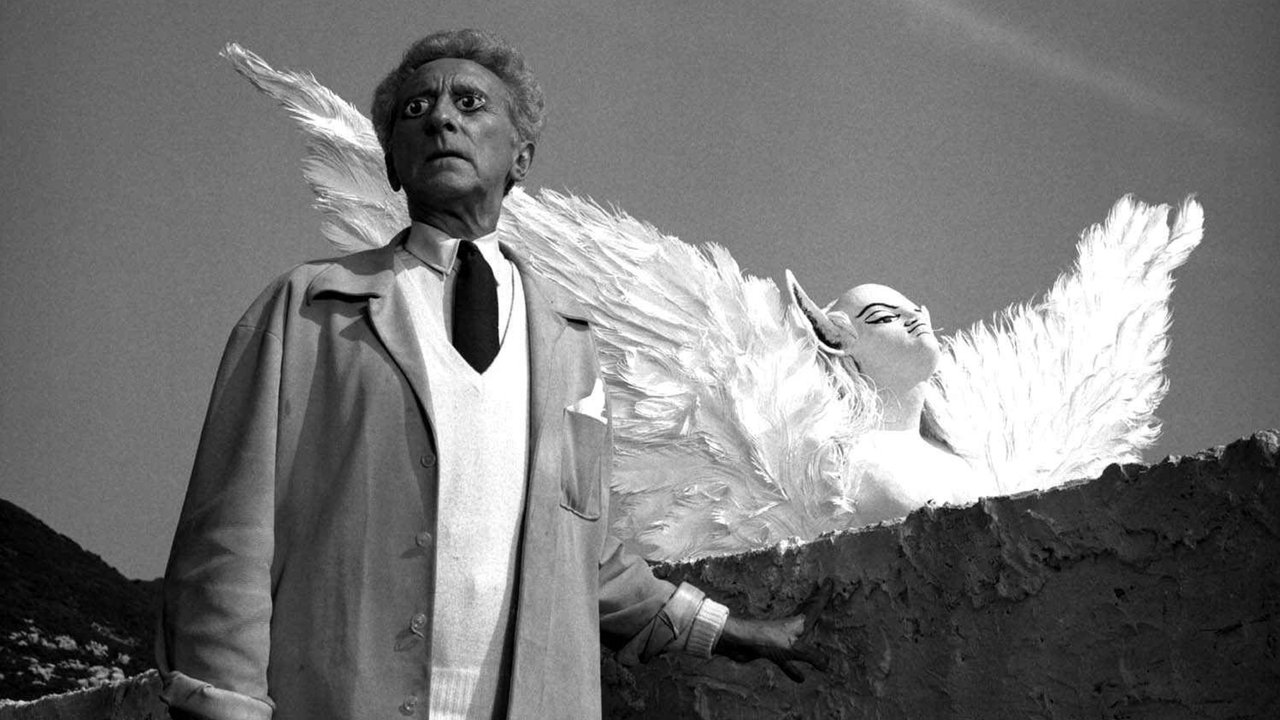
An 18th century poet travels through time in search of divine wisdom. In a mysterious wasteland, he has a series of enigmatic encounters with symbolic phantoms with whom he muses about the nature of art and his own career. Ultimately, the poet strives to achieve his rebirth as a celestial being.
Critics Sentiment
Cocteau finds comfort in the immortality of art as his final testament
Cocteau faces a surreal bureaucratic tribunal for creating his characters
The film's biggest swing is the rise from the static, theatrically awkward tribunal sequence (6.5) to the visually stunning red hibiscus colour intrusion (8.5), a gain of 2.0 points across roughly 30 minutes.
Audience sentiment for Testament of Orpheus follows a gently undulating arc that rises toward a deeply felt conclusion, with early enthusiasm for Cocteau's personal framing giving way to mild frustration at repetitive slow-motion techniques and a theatrically stiff tribunal sequence before recovering strongly through the film's most celebrated visual coups. The red hibiscus colour intrusion and the closing meditation on artistic immortality represent the film's emotional and critical peaks, widely praised as genuinely moving and visually inventive. Overall the film is received as a flawed but irreplaceable farewell, valued most by viewers already invested in Cocteau's world and the Orphic trilogy.
Full cast
Showing 20 of 27
Jean Cocteau
Le poète

Édouard Dermithe
Cégeste(non crédité)

Henri Crémieux
Le professeur(non crédité)

François Périer
Heurtebise(non crédité)

Claudine Auger
Minerve (non crédité)

Françoise Arnoul
Elle-même (non crédité)

Lucia Bosè
Une amie d'Orphée(non crédité)

Charles Aznavour
Le Curieux(non crédité)

Brigitte Bardot
Elle-même (non crédité)

Jean Marais
Oedipe

Daniel Gélin
L'interne (non crédité)

Françoise Christophe
L'infirmière (non crédité)

Nicole Courcel
La mère maladroite (non crédité)

Daniel Moosmann
2e Homme-Cheval (non crédité)

Yul Brynner
L'huissier (non crédité)

Pablo Picasso
Un ami d'Orphée (non crédité)

Michael Goodliffe
Narrateur anglais (voix) (non crédité)

Jean-Pierre Léaud
Dargelos, l'écolier

Alice Sapritch
La Reine des Gitans (non crédité)

Roger Vadim
Elle-même (non crédité)
Crew
Write a Review
Rate each story beat:
0 of 8 rated
Beats you skip are left out of your arc.